AI Anime Song Generator
Loading...
How to create anime music with AI
Pick the scene type and style
Is this an opening, an ending, a battle insert, a quiet emotional moment? Put that in the occasion field. Then choose a style: J-rock, orchestral, acoustic, synth. The scene type and style together set the template.
Write the moment
In the long field, describe what's happening on screen when this song plays. A character revelation, a goodbye, a training montage, a final stand. Narrative beats translate directly into musical structure. Be specific about the emotional turn.
Generate and feel the timing
Hit Generate. Listen for whether the climax hits at the right story beat. If the build is too fast, add 'slow build, the moment takes time to arrive' to your description. If the energy is wrong, adjust the style tag. Each generation reinterprets the scene.
Music that follows story beats, not just chorus timing
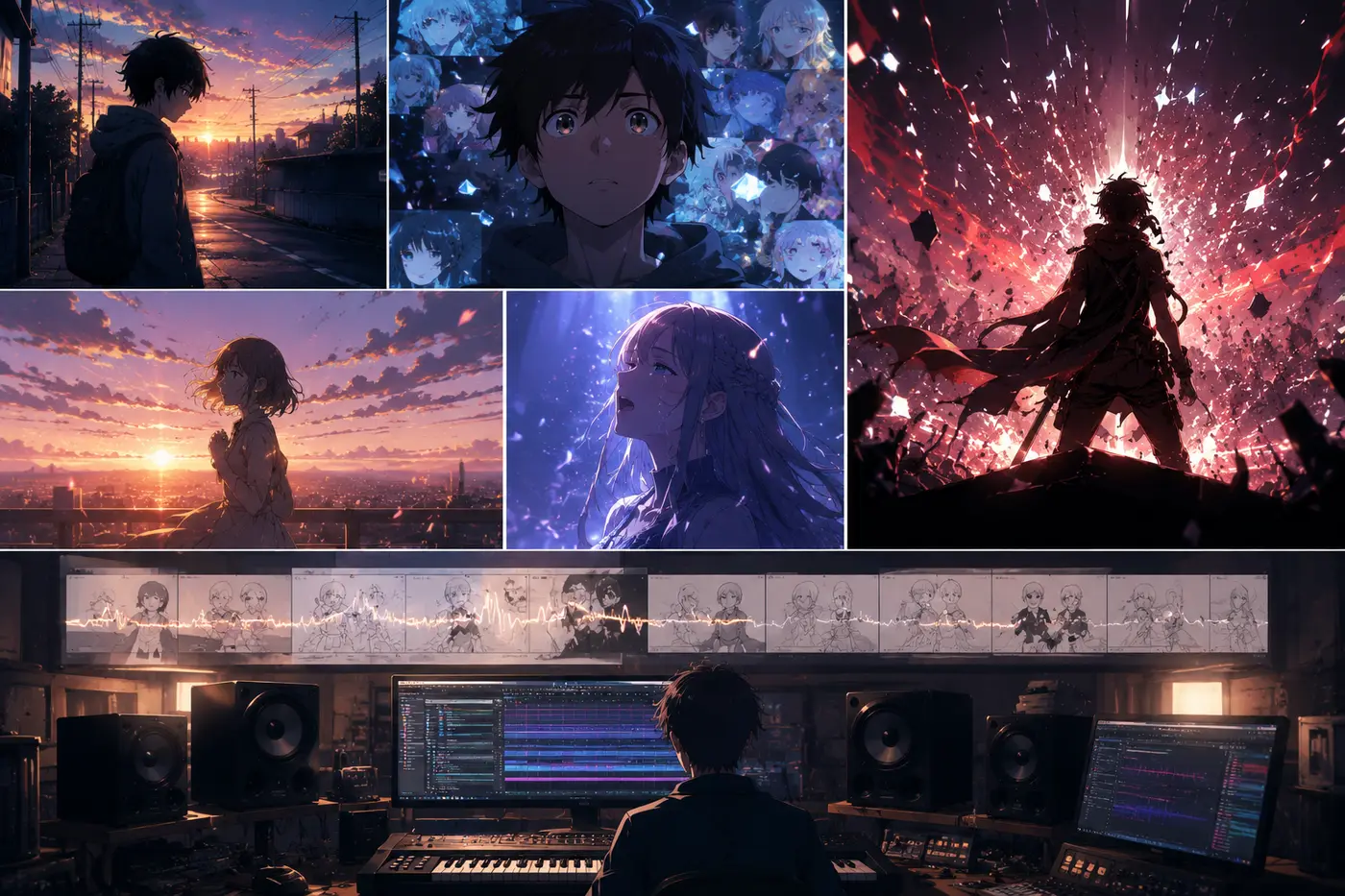
Anime songs pace themselves around narrative moments. The quiet verse mirrors a character walking alone. The pre-chorus builds as memories flash. The chorus arrives at the exact second the character makes their choice. The AI generates with this narrative pacing. A shonen battle opening starts with a short instrumental burst, then pulls back for a verse that gathers energy, then erupts into a chorus meant to sync with rapid title-card cuts. An emotional insert song does the opposite: starts fragile, lets the instrumental swell slowly, and peaks at the moment in the story where the tears would fall. This is different from pop structure, which peaks and returns to the verse regardless of narrative context. Anime music stays on the story's clock. The AI reads your scene description and times the musical climax to match the emotional peak you described.
Describe the scene, not the song
Anime music doesn't exist in a vacuum. Every opening, every insert song, every credits track sits inside a story. The form works with that. The short fields frame the context: who the song is about, what kind of scene it serves, and a style tag. The style tag carries a lot. 'J-rock opening, shonen' and 'acoustic ending, slice of life' produce songs from opposite ends of the anime spectrum. But the long field is where the song finds its identity. You describe the narrative moment. Not musical instructions. A story beat. Write 'the villain reveals they were protecting the hero all along, rain starts falling, the hero reaches out but they're already gone' and the AI builds a song around that emotional arc. The music follows the story the way it would in an actual anime episode. The better the scene description, the more precisely the emotional timing lands.
Why create anime songs with SunoPrompt
Anime music production requires composers who understand both music and narrative timing. This puts both skills into the text field.
Narrative timing, not musical timing
The AI doesn't peak at a fixed bar number. It peaks where your story peaks. Describe a character revelation at the bridge and the music builds to that point. Describe a quiet realization at the end and the track tapers instead of resolving with a final chorus. The song follows the scene.
OP, ED, and insert as distinct formats
These are not just labels. An opening compresses energy into 90 seconds. An ending stretches reflection across a gentle fade. An insert song has no time constraint and can be as long or as brief as the scene requires. The AI generates with format-specific structural rules.
Anime genre awareness in production choices
Writing 'shonen' loads electric guitars, driving drums, and vocals that push hard. Writing 'slice of life' loads acoustic instruments and a conversational vocal delivery. Writing 'dark fantasy' loads minor-key orchestral textures and choral elements. The anime genre tag shapes the entire production palette, not a single instrument swap.
Scene descriptions as production briefs
You don't need to know music terminology. Describe what's happening on screen. 'Hero falling through clouds, memories scattering like light, catching one and holding on.' The AI translates that visual into a composition. The falling becomes a descending melodic line. The scattering becomes scattered arpeggios. The holding on becomes a sustained chord. Visual thinking works here.
Vocals that match character energy
The voice doesn't sing neutrally. It carries the character's emotional state. A battle scene gets a vocal that pushes and strains. A farewell scene gets a vocal that holds back and cracks at the edges. The AI adjusts delivery based on your scene description rather than applying one vocal style to everything.
Full toolkit
Anime music is one part of the soundtrack
The AI Anime Song Generator covers OP, ED, and insert songs. SunoPrompt's other tools handle lyrics, broader genre production, and stem separation for remixing or scene editing.
AI Music Generator
For non-anime tracks in your project. If you need a jazz piece for a cafe scene or an electronic track for a cyberpunk sequence, the main generator handles it. Same form, different style tag, same history keeping everything in one place.
Lyrics Generator
Write lyrics that match your anime scene's emotional beats. Feed it the same narrative description you used for the song: 'lyrics for a farewell scene, bittersweet, the character smiles while crying.' The output comes back tuned to anime lyric conventions, shorter phrases with emotional weight at the line endings.
Vocal Remover & Stem Splitter
Pull the instrumental from a generated anime track to use as background music under dialogue. Isolate the vocal to hear the melody line on its own. Separate the drums to check whether the rhythm drives the scene forward at the right pace.
Explore more AI music tools
Who creates anime music with this
Animators and indie creators
Generate opening and ending themes matched to your original anime, short film, or animated project
Create insert songs for specific scene moments without commissioning a composer
Produce multiple variations for the same scene and pick the one that syncs best with your animation timing
What is an AI anime song generator?
An AI Anime Song Generator produces original anime-style music from a scene description. You describe a narrative moment and pick a style, and the AI creates a complete track with the emotional pacing, vocal energy, and instrumental character that define anime openings, endings, and insert songs. No composition background needed.
Anime music is scene music, and that changes everything
Pop songs stand alone. Anime songs don't. An anime opening exists to set the tone for 24 episodes. An insert song exists to break you at minute 18 of episode 11. A credits theme exists to hold you in the feeling the episode just created. This functional specificity is why anime music sounds different from regular J-pop or J-rock. The structure serves narrative timing, not radio formatting. The AI generates with this awareness. When you write 'opening' the track front-loads energy. When you write 'insert song, emotional turning point' the track builds slowly and peaks late. The song's job inside the story determines its shape.
Openings, endings, and inserts follow different rules
An anime opening (OP) has about 90 seconds to grab you. It starts fast, usually with an instrumental hook or a vocal burst, then runs at high energy through a compressed verse-chorus. An ending (ED) inverts that: it starts mid-emotion, carries a reflective mood, and fades rather than resolving. An insert song has more freedom. It can be 30 seconds of piano under dialogue, or a full 4-minute power ballad that takes over the entire scene. Write 'OP' or 'ED' or 'insert song' in your style field and the AI structures the track accordingly. Each format has its own pacing template.
Genre inside anime: shonen, slice of life, mecha, fantasy
The same 'anime music' label covers wildly different sounds depending on the show's genre. A shonen battle anime needs driving drums, electric guitar, and vocals that sound like the singer is fighting alongside the characters. A slice-of-life show needs acoustic guitar, gentle piano, and a voice that sounds like a conversation with a close friend. Mecha wants synth and orchestral layering. Dark fantasy wants minor-key strings and choral passages. Write the anime genre in your style field: 'shonen J-rock,' 'slice of life acoustic,' 'dark fantasy orchestral.' The AI maps each to a specific production approach.
The story field as a storyboard
Think of the long text field as a storyboard description. Not 'sad and beautiful' but 'the protagonist watches the train pull away from the platform, they don't wave, they stand there until the train is a dot, then they look down at the ticket the other person left in their pocket.' That level of scene detail gives the AI a three-act structure within the song: arrival, departure, discovery. Write 'flashback montage: childhood running through fields, then the same fields empty and overgrown, then the character as an adult standing at the edge' and the AI paces the music through nostalgia, loss, and quiet resolution. Scene specifics produce better songs than emotion labels.
Vocals that carry character, not just melody
Anime vocals aren't neutral. They carry a character's energy. A shonen opening vocalist sounds like they're pushing past their limit. A romance ED vocalist sounds like they're admitting something they've been holding back. The Voice Gender selector sets the base tone, but the style tag and scene description shape the delivery. Pick Female with 'magical girl, hopeful, dawn breaking' and the vocal is bright, ascending, full of forward motion. Pick Male with 'rival character, alone on the rooftop, conflicted' and the delivery gets rougher, more restrained, with breaks in the sustained notes. The voice acts the scene.
How this differs from a generic AI music tool
Generic AI tools structure songs for standalone listening. Anime songs are structured for narrative context. The AI times the musical climax to match the story beat you describe rather than defaulting to a verse-chorus peak at a fixed point in the track.
Most generators don't distinguish between an opening and an ending. An anime OP is compressed and high-energy. An anime ED is reflective and slowly fading. This tool treats them as structurally different formats with different pacing, energy curves, and resolution points.
A standard tool applies the same vocal approach throughout the track. Anime music needs vocals that change with the story: restrained in the verse, breaking open at the chorus, raw in the bridge. The AI shifts vocal intensity across sections to match the narrative arc you described.
Other generators produce music that sounds polished and generic. Anime music is genre-specific to the show's world. Shonen, mecha, slice of life, dark fantasy all need different production identities. The AI loads a distinct sonic palette for each anime genre rather than filtering the same base sound.