AI ToolboxAI Hip Hop Beat Generator

AI Hip Hop Beat Generator

Beat subject or theme
Context
Hip hop sub-style
Beat vibe and feel
人聲性別隨機
消耗: 40 點數

Loading...

How to make hip hop beats with AI

01

Name the sub-style and set the scene

Type a specific hip hop sub-style into the style field. Then describe the vibe in the long field. Think about where someone would hear this beat: a car, a stage, a bedroom studio. The location shapes the sound.

02

Pick a voice or go instrumental

The Voice Gender selector adds a vocal layer. For pure instrumentals, write 'instrumental only' in your mood field. If you want a hook or ad-libs over the beat, pick Male or Female and the AI adds a vocal that sits behind the rhythm.

03

Generate, compare, keep the pocket

Hit Generate. The beat arrives in about a minute. Listen for the pocket, that locked-in groove between the kick and snare. If it's close but not right, adjust one word in your mood field and run it again. Small changes produce different drum feels.

Beat anatomy

What the AI actually puts in your beat

A hip hop beat has layers. Drums on top. Bass underneath. Something melodic floating through the middle, usually a sample or synth line. The AI builds all three. Drum patterns follow your sub-style. Trap gets a kick-snare-hat grid with rolling hi-hat variations. Boom bap gets a chopped breakbeat feel, slightly off-grid, with that swing. Drill gets sliding 808s and sparse, hard-hitting drums. The bass layer adapts too: long 808 tails for trap, punchy kicks for boom bap, distorted sub-bass for drill. The melodic layer is where the mood field shows up most. 'Melancholy piano loop' gives you a different beat personality than 'aggressive synth stabs.' The AI picks instruments that match your description and keeps them out of the vocal frequency range.

Create Hip Hop Song
Producer brief

Fill out a producer brief, not a songwriting form

You're not writing a song here. You're commissioning a beat. The three short fields set up context: what the beat is for, where it lives, and what sub-style it follows. The sub-style field matters most. 'Trap' and 'boom bap' don't share a single production convention. They differ in tempo, drum source, bass character, and how much space sits between the hits. The long field is your vibe note. Real producers get these from artists all the time: 'something dark, like I'm walking through fog' or 'high energy, block party, everyone's outside.' It's not technical. It's directional. The form is built for people who know what they want to hear but don't know how to build it in a DAW.

Hip Hop Song AI Generator

Why make hip hop beats with SunoPrompt

Beat production normally requires a DAW, drum kits, synth plugins, and years of practice. This gets you to the beat in a minute.

Beat-first, not song-first

The AI treats the instrumental as the final product, not a backing track for vocals it generates. Drum patterns, bass lines, and melodic elements are mixed to stand on their own. The vocal range stays open because the beat expects a rapper to fill it later.

Sub-style precision from a text tag

Typing 'boom bap' versus 'trap' doesn't apply a preset on top of a generic beat. It changes the drum programming method, the bass synthesis approach, the tempo, and the sample palette. The AI builds from different foundations depending on your sub-style, the same way a real producer would.

No DAW, no plugins, no learning curve

FL Studio takes weeks to learn. Buying drum kits and synth presets costs money and time. Here, the style tag and vibe description replace all of that. You type what the beat should feel like, the AI handles everything between your description and the finished audio file.

Find the pocket through iteration

The pocket is that locked-in groove where the kick, snare, and bass align and your head starts nodding. It's hard to engineer deliberately. Generate a beat. If the pocket isn't there, change one phrase in the mood field. Run again. The AI interprets each version slightly differently. Five tries in five minutes usually lands one beat with the right groove.

History as a beat library

Every generated beat saves to your history. After a few sessions you have a personal library organized by the moods you described. Scroll back through old beats when you need something for a new verse. The library grows with you instead of requiring separate purchases from beat stores.

Full toolkit

The beat is the start, not the finish

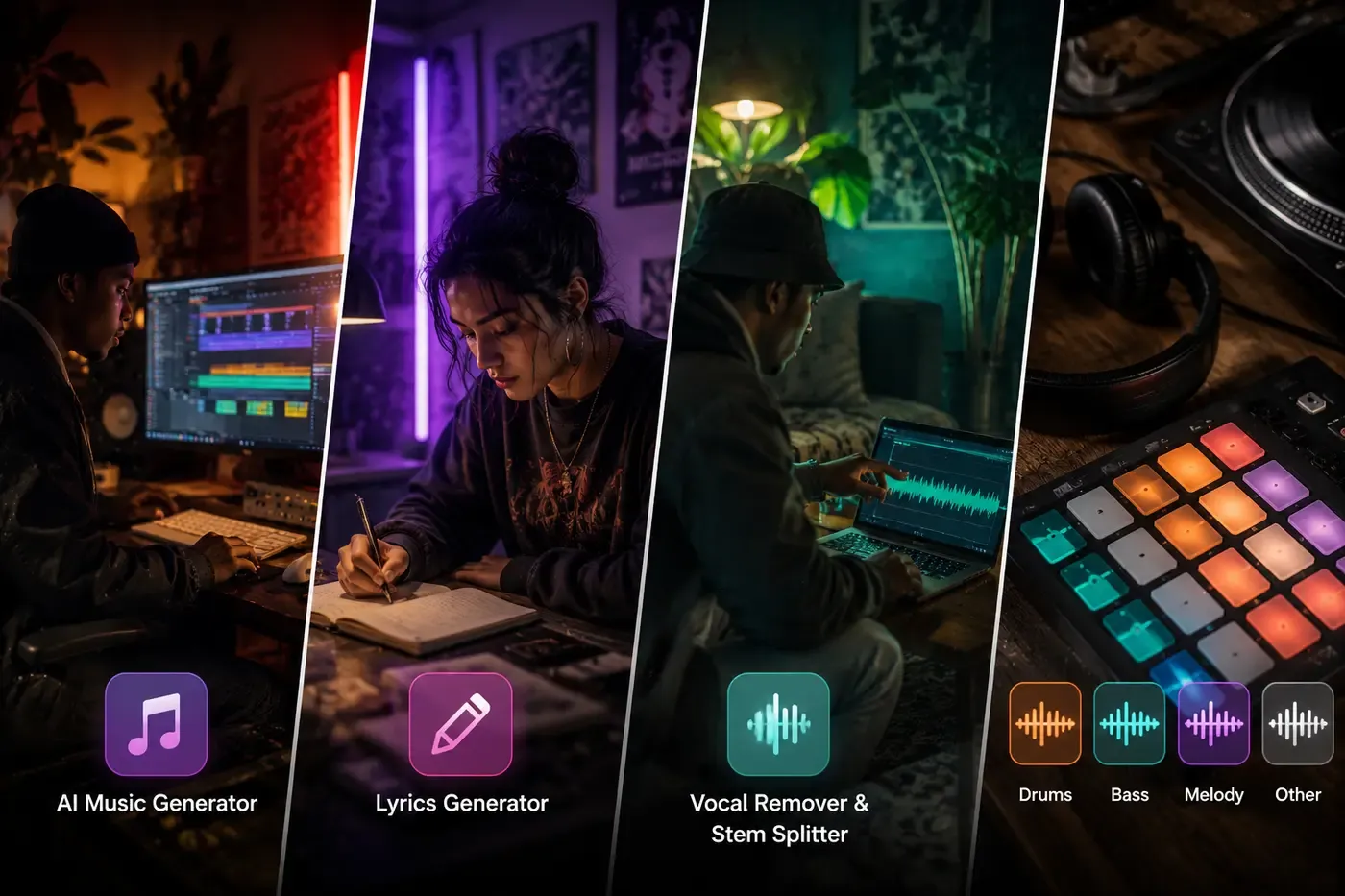
Once you have a beat, SunoPrompt's other tools handle the rest. Write lyrics to match it, generate a full song over it, or isolate individual stems. Everything stays in one place.

AI Music Generator

The full song engine. Takes the same kind of input but produces a complete track with vocals baked in. Use it when you want the finished product, not an instrumental waiting for a voice.

Lyrics Generator

Write lyrics that match your beat's mood. Feed it the same vibe description you used for the beat, and the words will land in the same emotional territory. Useful when you have the instrumental but the bars aren't coming.

Vocal Remover & Stem Splitter

Pull your generated beat apart. Isolate the drums from the melodic elements, or extract the 808 layer. Good for remixing your own beats or checking if individual layers hold up on their own.

Hip Hop Song Generator

Explore more AI music tools

Who uses the AI hip hop beat generator

Rappers and vocalists

Generate beats to freestyle over without waiting on a producer or browsing beat marketplaces

Describe your flow style in the mood field and get instrumentals that match your pace and energy

Build a catalog of custom beats tuned to your voice and delivery rather than settling for generic type beats

What is an AI hip hop beat generator?

An AI Hip Hop Beat Generator creates complete hip hop instrumentals from a text description. You describe a vibe and pick a sub-style, and the AI produces a beat with drums, 808s, and melodic elements. No FL Studio, no sample digging, no music theory.

Beats vs songs: why the distinction matters

A song has vocals, lyrics, structure built around a message. A beat is the foundation waiting for all of that. Most AI music tools generate songs. This one generates the instrumental. That means the AI makes different mixing decisions: it keeps the mid-range open for a rapper's voice, it doesn't layer dense melodies where verses would sit, and it builds the arrangement around drum patterns rather than vocal hooks. If you've ever tried to rap over an AI-generated 'song,' you know the vocals fight each other. A beat avoids that problem by design.

Trap, boom bap, drill: sub-styles are not cosmetic

Write 'trap' and the AI loads a specific template: 808 bass with pitch bends, rapid-fire hi-hats in triplet patterns, snares with heavy reverb, tempo around 130-160 BPM. Write 'boom bap' and everything changes: chopped drum breaks, punchy kicks without sub-bass tails, jazzy samples, tempo around 85-95 BPM. Write 'drill' and the 808s slide between notes, the hi-hats go double-time, and the overall feel turns cold and minimal. These are real production differences. The style field isn't a filter. It rewrites how the AI constructs the beat from the ground up.

The mood field as an artist brief

Producers get vibe references from artists before making beats. 'Something like late-night driving, windows down, kind of menacing.' That's a real producer brief. The mood field works the same way. Write 'empty basketball court, 6 AM, fog, streetlights still on' and the AI picks darker chord progressions, sparser drums, and a slower pace. Write 'packed club, everyone rapping along, peak energy' and the drums get denser, the 808 hits harder, and the tempo pushes up. Try describing a movie scene instead of a musical instruction. 'Car chase through rain' produces a more interesting beat than 'fast and aggressive.'

808s and drums: what you can steer with words

You can't turn a knob for 808 sustain length, but you can describe what you want. 'Long booming 808 that rings out' versus 'short punchy kick, no tail.' 'Rolling hi-hats, machine-gun speed' versus 'laid-back hi-hats with swing.' 'Snare with rim click sound' versus 'clap on the two and four.' The AI parses these descriptions and adjusts the drum programming. It's less precise than a DAW but faster. And for most people, knowing the difference between 'rolling triplet hi-hats' and 'simple eighth-note hi-hats' is enough to get the beat they hear in their head.

Vocal space is built into the mix

A common problem with AI-generated music: the mix is dense everywhere because the AI treats every frequency as available space. Hip hop beats need a hole in the middle where the voice sits. This generator carves that space automatically. The melodic elements stay low or high, the drums anchor the top and bottom, and the mid-range stays relatively clear. If you pick a voice option, the vocal sits in that space without competing. If you leave it instrumental, the space stays open for whatever you record later.

How this compares to standard AI music tools

Standard AI music tools generate complete songs with vocals mixed to the front. A hip hop beat generator produces instrumentals where the vocal frequency range stays open. The mixing approach is fundamentally different because the output serves a different purpose.

Most generators don't distinguish between hip hop sub-styles in any structural way. Here, typing 'trap' versus 'boom bap' changes the drum pattern source, the bass approach, the tempo range, and the melodic palette. The sub-style tag controls architecture, not decoration.

A typical tool optimizes for a finished, self-contained track. A beat is not self-contained by nature. It's designed to be rapped over, freestyled to, or extended. The AI generates with that in mind, leaving arrangement space where a performer would enter.

Generic generators fill every section with equal density. Hip hop beats need variation: a stripped intro, a verse section with fewer elements, a hook section that adds a melodic layer. The AI builds this dynamic structure based on hip hop arrangement conventions.

Frequently asked questions about AI hip hop beats