AI Jazz Generator
Loading...
How to make jazz with AI
Pick a sub-genre and set the room
Type a jazz style into the style field: smooth jazz, bebop, Latin jazz, whatever fits. In the long field, describe where the music is happening. A venue gives the AI more useful information than a list of adjectives.
Voice or instrumental
Most jazz works without vocals. For instrumental, write it in the mood field or leave voice on Random and let the AI decide. For vocal jazz, pick a gender and add a cue like 'intimate vocal, slow phrasing.'
Generate and listen for the conversation
Hit Generate. Pay attention to how the instruments relate. If the piano is too busy, regenerate with 'sparse piano, let the bass lead.' If you want more horn, say so. Each generation reshuffles the ensemble balance.
Instruments that respond to each other, not play in parallel
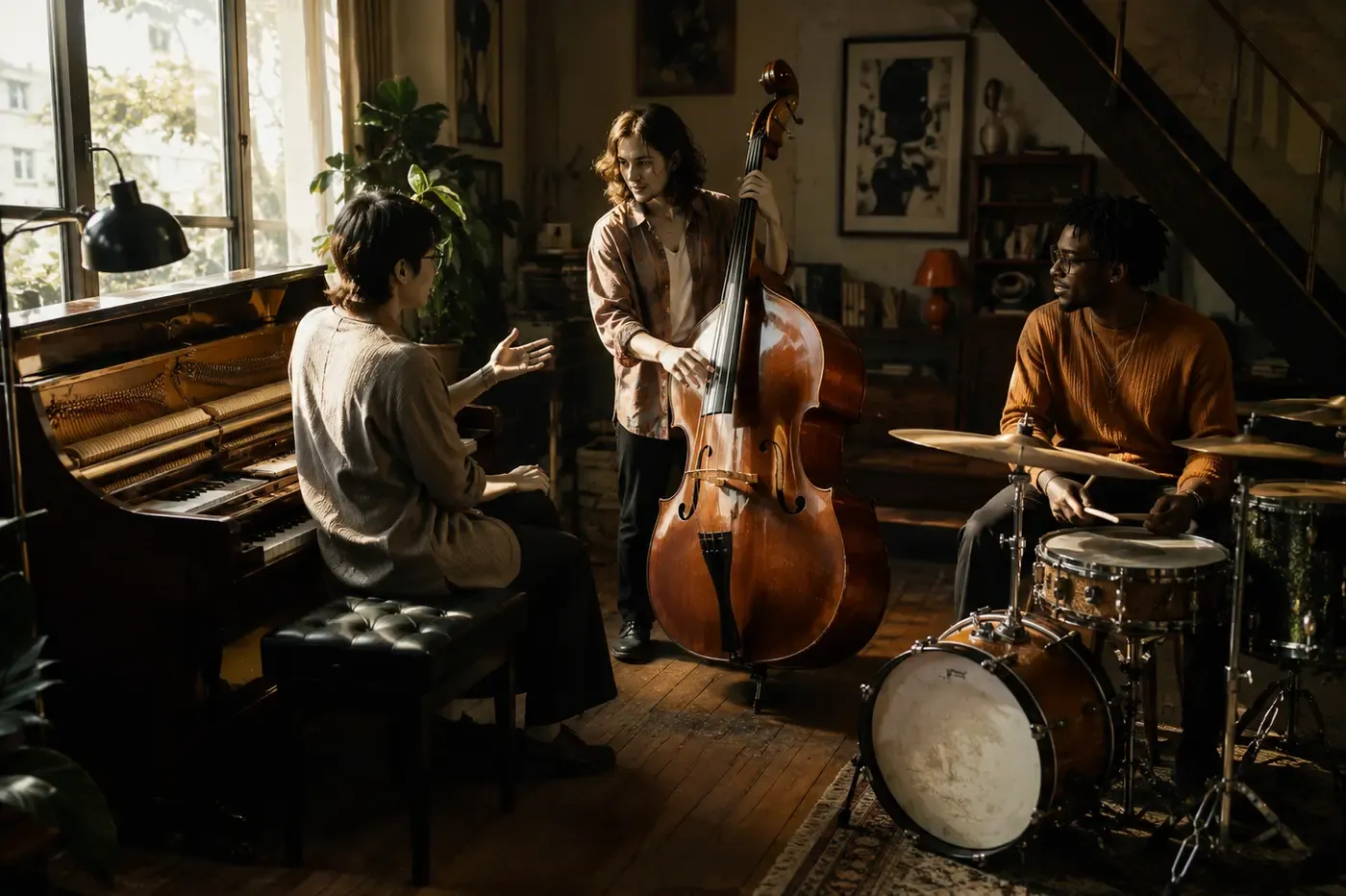
The thing that separates jazz from other genres: the piano doesn't ignore the bass. The drums react to what the horn is doing. Instruments listen to each other. The AI can't improvise in real time, but it generates parts that interlock. The piano comps around the melody instead of doubling it. The bass walks its own line. The drums shift between ride cymbal and hi-hat depending on intensity. When a horn takes a solo section, the rhythm section drops back. When the melody returns, everyone tightens up. This is arrangement intelligence, not a preset. The AI knows that in a jazz trio, the piano's left hand covers harmony while the right hand converses with whatever else is playing. That kind of role awareness shows up in the output.

Call the style and mood, the AI assembles the band
Jazz musicians don't get detailed sheet music for every gig. They get a style, a tempo, maybe a lead sheet. Then they play. The form works the same way. Your three short fields tell the AI what kind of session this is: a subject, a context, and a jazz sub-genre. The sub-genre does the most. 'Bossa nova' assembles a different set of instruments than 'hard bop.' The long field sets the room. Where is this band playing? For whom? At what hour? A trio playing at 2 AM in a basement sounds different from the same trio at a Sunday afternoon garden party. The AI reads your venue cue and adjusts the energy, the mix brightness, and how much space sits between the notes. You're not composing. You're booking a band and telling them the vibe.

Why generate jazz with SunoPrompt
Jazz production usually means hiring session musicians or spending years learning theory, arrangement, and recording technique. This gives you the result in a minute.
Ensemble intelligence, not layered loops
The AI generates parts that relate to each other. Piano voicings adjust to what the bass is doing. Drums respond to intensity changes. This is different from stacking four loops on top of each other and calling it a jazz track.
Jazz harmony without jazz theory
You don't need to know what a tritone substitution is. Type 'bebop' and the AI uses chromatic harmony. Type 'smooth jazz' and the chords stay diatonic with some color. The sub-genre tag encodes decades of harmonic convention so you can hear the result without studying the rules.
The venue shapes the sound
Describe where the band is playing and the AI adjusts dynamics, density, and energy. A basement club gets sparse, intimate arrangements. A concert hall gets fuller voicings and more projection. This is something most AI tools skip entirely. They generate at one dynamic level regardless of context.
Every generation is a different take
In jazz, the same tune sounds different every performance. Regenerating your prompt produces a genuinely different arrangement: new solo choices, different comping patterns, shifted dynamics. This is a feature of the genre that the AI reproduces naturally. You're not getting the same track twice.
From one track to a full set
Generate five tracks with related but shifting moods and you have a 10-minute jazz set. Start with 'late afternoon, relaxed' and end with 'midnight, the band is loose and pushing boundaries.' Your history keeps the arc. Build it over days or in one sitting.
Full toolkit
Jazz is one set in a longer night
The AI Jazz Generator covers jazz-specific tracks. The rest of SunoPrompt's toolkit handles everything outside the jazz club. All tools share the same account and history.
AI Music Generator
When you want to leave jazz territory entirely. Same form structure, but aimed at any genre: pop, rock, country, electronic. Useful if your project needs jazz for one scene and something else for the next.
Lyrics Generator
Jazz vocal tracks need lyrics that breathe. Short phrases, room for the melody to bend. The Lyrics Generator can write in that style if you prompt it with your jazz mood. Feed it 'late night, bittersweet, vocal jazz' and the words come back sparse.
Vocal Remover & Stem Splitter
Isolate the piano from a generated jazz trio track. Pull the bass line out on its own. Separate the drums to hear the brush patterns clearly. Stem splitting works well with jazz because the instruments occupy distinct frequency ranges.

Explore more AI music tools
Who generates jazz with this
Cafe and restaurant owners
Generate a full evening's worth of background jazz tuned to your venue's atmosphere
Avoid looping the same Spotify playlist your customers have heard at every other cafe
Shift styles through the day: bossa nova for brunch, cool jazz for afternoon, bebop for the late crowd
What is an AI jazz generator?
An AI Jazz Generator produces full jazz arrangements from a text description of style, mood, and setting. You pick a sub-genre, describe an atmosphere, and the AI assembles an ensemble that plays together with the harmonic complexity and rhythmic feel jazz requires. No charts, no theory, no session musicians.
Jazz and AI: a less obvious pairing than you'd think
Jazz is famous for spontaneity. AI generates from patterns. Seems like a contradiction. But jazz improvisation runs on vocabulary: scale fragments, chord voicings, rhythmic motifs that musicians have internalized from decades of recordings. The AI has absorbed that same vocabulary. It knows that a ii-V-I progression wants certain passing tones, that a walking bass line follows specific interval rules, that a drummer playing brushes uses different patterns than one on sticks. The output isn't spontaneous, but it speaks the language. And for most listeners, that's what makes jazz sound like jazz.
Sub-genres that actually sound different
Write 'smooth jazz' and you get a polished, mid-tempo track with a soprano sax melody over electric piano and a programmed-feel drum groove. Write 'bebop' and the tempo doubles, the harmony gets dense with chromatic substitutions, and the drums swing hard on the ride cymbal. Write 'bossa nova' and the rhythm shifts to a Brazilian pattern, the guitar replaces the piano, and the feel turns intimate. These are real structural differences the AI builds from scratch, not a filter applied to the same base track. Write 'jazz fusion' and you get electric instruments, odd meters, and a rock-influenced energy. Each tag calls up a different musical tradition.
The mood field as a venue description
Jazz sounds different depending on where it's played. A trio in a small club plays quiet, intimate, lots of space. The same trio on a festival stage projects, pushes harder, leaves less silence. The mood field lets you set that room. Write 'cocktail bar, Tuesday night, half-empty, bartender wiping glasses' and the AI generates something restrained and warm. Write 'packed jazz club, front row close enough to see the pianist's hands, crowd leaning in' and the intensity comes up. Try 'recording studio, late session, everyone tired but locked in' for something focused and precise. The venue shapes the performance the way it does in real life.
Chord language the AI already knows
Jazz harmony is dense. Seventh chords are the starting point, not the destination. Ninths, elevenths, thirteenths, tritone substitutions, chromatic approach chords. If you've tried to program jazz in a standard music tool, you know it defaults to simple triads and the result sounds like elevator music with a saxophone. This generator draws from jazz-specific harmonic patterns. The piano voicings include upper extensions. The bass notes imply chord movement even when the chords aren't stated. You don't need to know any of these terms. The sub-genre tag tells the AI which harmonic era to draw from.
Instrument roles and when they shift
In a jazz arrangement, roles aren't fixed. The piano comps during the melody, then takes a solo and becomes the lead while the bass and drums adjust underneath. The AI handles these role transitions within a single track. The output typically has a head (the melody statement), a solo section where one instrument steps forward, and a return to the head. Not every generation nails the balance. If the solo section runs too long or the drums are too loud, regenerate with a more specific instruction. 'Short piano solo, then back to the melody' works as a direction.
How this compares to a generic AI music tool
Generic AI music tools default to pop harmony: major and minor triads, simple progressions, predictable resolution. Jazz needs extended chords, chromatic movement, and tension that doesn't always resolve immediately. This generator uses jazz-appropriate harmonic language by default.
Most AI generators treat all instruments as layers stacked on top of each other. Jazz instruments interact. The AI generates parts that respond to each other: piano comping adapts to whether a horn is playing, drums shift pattern with the energy. This interplay is the difference between background music and something that sounds like a performance.
A standard tool quantizes everything to a grid. Jazz timing swings, pushes, pulls. The AI generates with swing feel and micro-timing variations that give the rhythm section a human-played quality instead of a sequenced one.
Other generators give you one arrangement and call it done. Jazz is the genre where the same tune sounds different every night. Regenerating the same mood description produces meaningfully different takes, different solo choices, different drum patterns, because the AI treats each generation as a new 'performance' of your brief.